Follow
Link copied to clipboard

Published Sep 13, 2026, 4:00 AM EDT
These shooters hit the mark years ago — why fix what isn't broken?
 Image: 2K Games
Sign in to your Polygon.com account
The 2000s represented a golden age for shooter games. Both first-person and third-person shooters saw a plethora of all-time classics released across a number of platforms during the aughts, while the immense success of consoles such as the PlayStation 2 and 3 and Xbox 360 helped spearhead the genre's push into the mainstream. More than two decades later, many of those games remain standard-bearers for shooters as a whole.
Many of the most notable shooters from the 2000s have been remade over the years, as their impact and enduring popularity make them attractive candidates for a modern overhaul. Others have received remasters, which aim to preserve the game's original experience while updating elements such as visuals, performance, resolution, and more for newer hardware. But which shooters from the 2000s remain so good that they still don’t need a full-blown remake? Let’s dive in. After all, we must "finish this fight."
Note: Games that have received remasters are eligible for this list, but those that have received a complete, ground-up remake are disqualified.
1
STALKER: Shadow of Chernobyl
 Image: THQ
Release date: Mar. 20, 2007
Platform: Windows PC
There are few shooters from the 2000s quite like STALKER: Shadow of Chernobyl. Set in an alternate version of the Chernobyl Exclusion Zone, GSC Game World's first-person shooter (FPS) throws players into a radioactive wasteland filled with mutants, hostile factions, bizarre anomalies, and valuable artifacts — all the while mixing traditional shooter gameplay with engaging RPG and survival-horror elements.
That combination makes simply surviving "The Zone" an adventure unto itself. Ammo and medical supplies are extremely limited (especially on higher difficulties), and firefights can turn into one-sided bloodbaths swiftly. Furthermore, the game's A-Life system helps enemies and creatures feel like inhabitants of the world rather than cannon fodder waiting around for the player to show up, then blow them up.
Shadow of Chernobyl might be rough around the edges, but that almost feels appropriate for a game this grimy, hostile, and ruthlessly atmospheric. A modern remake could certainly smooth out some of the game's more infamously janky elements (such as enemies occasionally getting stuck or quests reappearing), but doing so might also scrub away some of the weirdness that made STALKER such a cult classic in the first place.
2
Prey
 Image: 2K Games
Release date: July 11, 2006
Platforms: Windows PC, Xbox 360, Mac
Upon seeing a game with the title of Prey, you might be thinking: "Hey, wasn't that remade in 2017 by Arkane Studios to critical acclaim?" Although it shares the title, Arkane's 2017 Prey is an entirely different game than the 2006 original.
Developed by Human Head Studios, the original Prey follows Cherokee mechanic Tommy Tawodi after he, his girlfriend, and his grandfather are abducted aboard a gigantic alien vessel known as the Sphere. From there, things get progressively wilder and more intense, with Prey using portals, gravity manipulation, wall-walking, and Tommy's spirit-walking ability to flummox the player's sense of direction as well as traditional FPS expectations.
Those mechanics are what make Prey feel remarkably distinct even two decades later. Shooting enemies through portals, fighting while the room itself seems to turn upside down, and navigating environments that deliberately ignore the normal rules of physics give the game an identity that few shooters have successfully replicated since. A graphical touch-up would certainly be welcome, but rebuilding Prey from scratch risks changing the very strangeness that made this shooter memorable to begin with.
3
Crysis
 Image: EA
Release date: Nov. 13, 2007
Platform: Windows PC
Featuring utterly spellbinding graphics for its era, this Crytek-developed and Electronic Arts-published FPS pushed the boundaries of what a shooter could look like. Its cutting-edge, nearly photo-realistic visuals helped make Crysis a technical benchmark, while its open-ended environments gave players ample freedom in how they approached each encounter with enemies.
Main character Nomad, aka Delta Force soldier Jake Dunn, also had one of the game's defining mechanics at his disposal: the Nanosuit. Using stored energy, the suit allowed players to enhance Nomad's strength, speed, armor, and cloaking capabilities, opening up multiple ways to tackle both human and extraterrestrial enemies.
That combination of visual spectacle, sandbox combat, and the iconic Nanosuit still gives Crysis an identity all its own. And if you had a PC capable of running it at its highest settings upon release — a notoriously difficult task, to be fair — the experience was even more impressive.
4
Left 4 Dead 2
 Image: Valve
Release date: Nov. 17, 2009
Platforms: Windows PC, Xbox 360, Mac
While Telltale's 2012 The Walking Dead might be the best story-focused zombie game of the era, Valve's Left 4 Dead — one of its increasingly rare forays into traditional game development — was an eminently enjoyable cooperative zombie horde survival/FPS hybrid that was already a pleasure to play. Left 4 Dead 2 then improved on that formula in more or less every facet when it released — just under the wire at the end of the 2000s.
Left 4 Dead 2 expands the original formula with more campaigns, more weapons, new Special Infected, melee combat, and a new cast of survivors, but the real magic remains its relentless pacing. Valve's AI Director dynamically adjusts enemy placement, item availability, and the intensity of encounters, meaning even familiar campaigns can spiral into chaos in completely new and refreshing ways from one playthrough to the next.
That unpredictability is a huge part of why Left 4 Dead 2 has aged so well. The shooting is simple, and the objectives are immediately understandable, but four-player co-op can still turn into a glorious disaster the moment a Tank appears, or one teammate gets dragged away by a Smoker. Throw in years of community-created content and there is little reason to rebuild the game from scratch when the core experience remains this effective — and this much fun.
5
FEAR: First Encounter Assault Recon
 Image: Vivendi Universal Games
Release date: Oct. 18, 2005
Platforms: Windows PC, Xbox 360, PlayStation 3
If Valve's AI Director in Left 4 Dead 2 was an impressive feather in that game's cap, FEAR: First Encounter Assault Recon's astounding enemy AI was even more imposing. Playing this game truly felt as if you were in a battle of wits against extremely well-trained and brutal enemy combatants whose sole goal was to outwit, outmaneuver, and outgun you. Notably, the player boasts the ability to slow down time for a short duration — called "reflex time" in-game — giving players one trump card that the game's brutal AI couldn't recreate.
Beyond the sometimes punishingly harsh enemy AI behavior, FEAR also featured spine-tingling and genuinely spooky horror elements brought about by a mysterious little girl dressed in red, who conjures up paranormal hallucinations that send the player character hurtling headlong into peril. That imagery was heavily influenced by Japanese horror films such as The Ring, with long stretches of silence and unsettling apparitions making it feel as if something horrible could appear around the corner at any moment.
That slow-burn horror stood in stark contrast to FEAR's blisteringly fast firefights. Enemies flank, take cover, communicate with one another, and generally refuse to stand around waiting to be shot, forcing the player to rely on speed, reaction time, and constant repositioning. Reflex time provides a brief advantage when things get overwhelming, but the game can go from eerie silence to a frantic, debris-filled shootout in seconds. Plenty of shooters have copied bullet time, paranormal horror, or aggressive enemy AI since 2005, but few have blended all three as effectively as FEAR.
6
Call of Duty 4: Modern Warfare
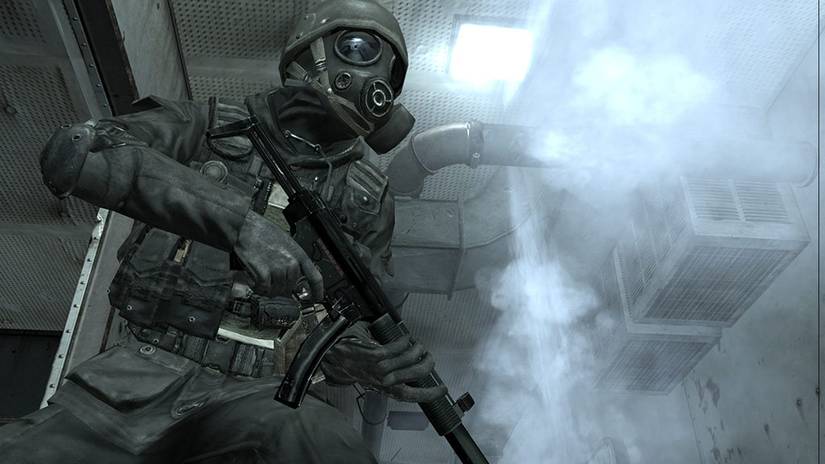 Image: Activision
Release date: Nov. 5, 2007
Platforms: Windows PC, Xbox 360, PlayStation 3, Mac
While 2007's Call of Duty 4: Modern Warfare wasn't the first Call of Duty game, it did more or less define the direction that the franchise would take over the course of the next two decades — in no small part due to CoD4's immensely satisfying gameplay, its tremendous action set pieces, and the supremely high-caliber production values that Infinity Ward put on display in this classic FPS from the genre's arguable golden age.
Sure, Call of Duty might have returned to this well time and time again with mixed-to-middling results, including direct sequels to the original Modern Warfare via Modern Warfare 2 in 2009 and Modern Warfare 3 in 2011, but the original remains the best due to the sheer scale of some of the game's most memorable moments. The sinking cargo ship in "Crew Expendable," the nuclear blast and ensuing helicopter crash in "Shock and Awe," and the hostage rescue aboard an airliner in the post-credits "Mile High Club" all remain among the campaign's defining set pieces.
Throughout, the gunplay is realistic and frenetic, and the game's best-in-class sound design keeps players riveted to their screens as bullets whizz and zing and the shouts of enemy combatants ring out around them. It's a transcendent shooter experience that has aged exquisitely in its original form, though a 2016 remastered rendition gussied up the graphics for the modern age, and a 2019 reimagined reboot reset the series in a new continuity rather than remaking this 2007 classic.
7
Gears of War 2
 Image: Microsoft Game Studios
Release date: Nov. 7, 2008
Platforms: Xbox 360
While it was the original Gears of War that received the iconic trailer featuring the dulcet tones of Gary Jules crooning "Mad World" over shots of Marcus Fenix obliterating Locusts, its sequel, Gears of War 2, was the superior game and the one that launched one of the most important (and memorable) elements of the franchise: the multiplayer, Locust-bashing bonanza that is Horde Mode.
Beyond that influential enemy-wave-filled survival mode, the game's campaign was easily among the series' best. Any time a game includes a "living level," which GoW2 did when Fenix and his fellow COGs get swallowed up by a colossal, eight-to-ten-mile-long Riftworm, you know you’re in for a viscerally good time. The resulting chapter, appropriately titled "Intestinal Fortitude," lives up to that promise, as Delta Squad battles its way through the creature’s insides before quite literally cutting its multiple hearts out from within.
Gears of War 2 also expanded on the original's already excellent cover-based third-person shooting with new weapons, chainsaw duels (just keep mashing B), larger-scale encounters, and a more ambitious story. It sold more than two million copies in its opening weekend alone, while Horde Mode became one of the game's most enduring contributions to the shooter genre. Nearly twenty years on, the game's combination of weighty gunplay, grisly spectacle, and over-the-top set pieces still feels quintessentially Gears and stands on its own merits as one of the best shooters of the 2000s — no remake required.
8
Halo 2
 Image: Microsoft Game Studios
Release date: Nov. 9, 2004
Platforms: Windows PC, Xbox
Surely, the original Halo game (2001's Halo: Combat Evolved) serves as the premier entry in the franchise's history, as its unique setting, incredible musical score, and rock-solid gameplay and production values made it one of the most important pieces of media — not just video games — of the 21st century. However, seeing as a ground-up remake of the game — Halo: Campaign Evolved — was released on July 28, 2026, it simply cannot be included. Instead, its sequel, Halo 2, represents the franchise with aplomb herein.
While there are those that prefer the streamlined, near-flawless gameplay of the first Halo game, in which you remain Master Chief the entire time as the player character, being able to branch out and play as disgraced Elite the Arbiter — acted to perfection by the velvet-voiced Keith David — served as an enjoyable (and frankly unexpected) counterpoint. Beyond that, the scale of Halo 2 was a tremendous step up from the original's already expansive world-building, with the Covenant receiving considerably more depth and its internal politics becoming an integral part of the story. Some may question Gravemind's deus ex machina powers or the somewhat weak melee-focused boss battle against the Prophet of Regret, but those blemishes do little to diminish the scope of Bungie's ambitious sequel.
Ultimately, Halo 2 delivered a vastly enjoyable sci-fi shooter experience that expanded nearly every aspect of what made the original so special while also finally allowing players to wield the game's iconic Energy Sword. For that reason alone, it deserves its flowers. Or at the very least a hearty "wort wort wort."
9
BioShock
 Image: 2K Games
Release date: Aug. 21, 2007
Platforms: Windows PC, Xbox 360, PlayStation 3, Mac
"Would you kindly" name me one of the best and most inventive shooter games of the past 20 years? Yep, you got it: the 2K-developed and -published, Ken Levine-directed BioShock from 2007. With one of the most memorable opening sequences in gaming history, players are introduced to the singularly unique setting of Rapture. What follows is a philosophical exploration into the follies of humanity, set to a thrilling, eminently addictive FPS game that will have you wanting to replay sections again and again to explore, experiment, and simply exist in what is one of the most exquisitely rendered game worlds of all time.
Gameplay-wise, BioShock gives players far more to work with than a standard arsenal of guns. Plasmids allow the player character, Jack, to wield powers ranging from electricity and fire to telekinesis, while Big Daddies, Little Sisters, Splicers, and Rapture's security systems constantly encourage experimentation when attempting to thwart or defeat them. Electrifying an enemy standing in water or turning the environment itself into a weapon remains just as satisfying now as it was in 2007.
Looming over everything is Andrew Ryan, whose failed utopian vision gives the game much of its philosophical weight, while the eventual revelation surrounding Jack and the phrase "would you kindly" remains one of gaming's greatest plot twists. Between its flexible combat, unforgettable setting, and layered story, BioShock remains a masterclass in video game design. Does the remastered version from 2016 look prettier? Surely. But would you kindly just leave this classic untouched by any further modern meddling?
10
Half-Life 2
 Image: Valve
Release date: Nov. 16, 2004
Platforms: Windows PC, Xbox, Xbox 360, PlayStation 3, Mac
One of the greatest games of all time from one of the best developers of the era, Half-Life 2 represented a quantum leap forward for a franchise that was already known for pushing the envelope for shooters via incredible in-game storytelling, thrilling gameplay, masterful AI programming, and memorable characters — one Resonance Cascade at a time. After six years, the Half-Life franchise returned with more heart, more thrills, a grander scope, and (as expected) far superior graphics depicting sweeping dystopian vistas alongside an expansion of the tremendous world-building that Valve achieved with the first Half-Life game in 1998.
Whether it's battling it out with the Hunter-Chopper in "Water Hazard," cruising down Highway 17 with Alyx Vance in the appropriately named "Highway 17" chapter, or being sure not to touch the sand in "Sandtraps" (beware of Antlions), Half-Life 2 represents the pinnacle of the shooter genre from the 2000s. Who knows if this more-or-less perfect game from over 20 years ago will ever get a sequel, but there is no denying that this FPS serves as Valve's crowning achievement and one of the finest shooters of all time.
>> Home