Sixteen years ago this month, Square Enix and Disney delivered the best Kingdom Hearts game — by finally putting Kingdom Hearts ahead of Disney.
The Kingdom Hearts 4 hype train is full steam ahead these days. Following a dazzling gameplay trailer revealed during June’s Nintendo Direct, Square Enix and Disney confirmed a late 2027 release window for the anticipated sequel at D23 in August. The news ultimately led to the entire series surging up Steam’s bestseller charts. There's a good reason for that. With more than a dozen games in a franchise known for its convoluted lore, there’s a lot to brush up on before KH4 arrives.
The 2010 PlayStation Portable game Kingdom Hearts Birth by Sleep is among the most important chapters to revisit. It explains one of the series’ most baffling mysteries, establishes the real origins of its central conflict, and introduces three heroes who become active players in that conflict by the end of Kingdom Hearts 3. It also offers something the central trilogy rarely does: an intimate, tragic story that doesn’t need Sora, Donald, and Goofy at its center.
Set roughly a decade before the original Kingdom Hearts, Birth by Sleep begins with friends Terra and Aqua taking their Mark of Mastery exam under their teacher, Master Eraqus, while the younger Ventus looks on. Aqua earns the title of Keyblade Master, but Terra fails after the darkness within his heart is revealed. Soon afterward, mysterious creatures called the Unversed start appearing across the worlds, and fellow Keyblade Master Xehanort disappears. Eraqus sends Terra and Aqua to investigate, while Aqua also receives secret orders to monitor Terra and bring home Ventus, who has rushed after his friends. Their pursuit becomes three intersecting journeys through the same worlds as Xehanort manipulates each hero toward a catastrophic confrontation.
Warning: Major spoilers for Kingdom Hearts Birth by Sleep follow.
The main Kingdom Hearts games often give me a strange sense of voyeurism. Sora and his Disney companions travel through condensed versions of classic movies, meet their heroes, and help nudge their plots toward the familiar endings we already know. At their weakest, these adventures feel like theme park attractions. Sora experiences someone else’s story before using his big key to lock the world away from darkness.
Even in the first game, things get the most interesting when we visit novel worlds and meet characters unique to Kingdom Hearts. Hollow Bastion, the World That Never Was, and the other original settings are where the series’ labyrinthine mythology and most memorable character drama take over. Birth by Sleep still includes plenty of Disney material, from classic princess stories like Snow White and the Seven Dwarfs and Sleeping Beauty to a surprising space setting based on Lilo & Stitch. But these places serve the journeys of Terra, Ventus, and Aqua rather than reducing the three heroes to tourists.
Three lonely heroes make Kingdom Hearts feel more intimate
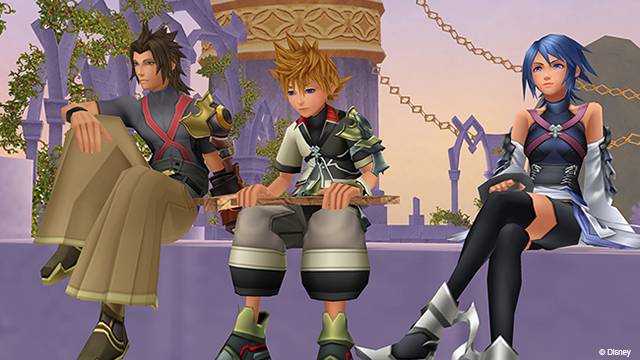 Image: Square Enix / Disney
The game tells that story across three campaigns, and players can choose which hero to follow first. The worlds unfold in different orders depending on that choice. Each hero arrives at a different moment and impacts the world in varied ways that the others discover later. They repeatedly cross paths and even reunite for a terrific three-way battle mid-game, but they never understand the nature of Xehanort’s plan until it’s too late for all of them.
That structure turns the usual isolation between Kingdom Hearts characters into one of the game’s greatest strengths. Riku and Kairi spend long stretches of the main trilogy pursuing their own distant objectives while Sora hangs out with Donald and Goofy. Despite their seemingly cosmic importance, they more often than not feel like side characters.
In Birth by Sleep, Terra, Ventus, and Aqua travel alone, yet their friendship remains palpable because their campaigns constantly orbit one another. Seeing only fragments of the other two journeys lets players feel that separation, the loneliness, and the burden of duty. Finishing all three finally brings it all together for a tragic finale.
Nobody here fights like Sora
The trio also provides perhaps the series’ single most satisfying version of its combat. The opening of the original Kingdom Hearts famously asks players to choose among a sword, shield, and staff, then sacrifice one of the remaining options. Terra, Ventus, and Aqua initially appear to reflect similar archetypes, but they don’t fit neatly into the role of fighter, rogue, and mage.
Terra’s heavy Keyblade swings give his attacks the weight of a massive sword. Ventus holds his Keyblade in a reverse grip, darting around enemies with rapid attacks and wind magic. Aqua dances across the battlefield, mixing graceful physical combos with the strongest command of magic. She initially feels less explosive than her buddies, but her attacks excel at controlling groups long before her best spells become available.
Birth by Sleep’s Command Deck system deepens those distinctions without becoming as busy as Kingdom Hearts 3’s transformations, team attacks, and other flourishes. Players equip individual attacks and spells, use them until they level up, then meld them into more powerful abilities. That process makes experimentation feel rewarding.
Filling the Command Gauge also activates temporary Command Styles based on how each character has been fighting. Terra’s Dark Impulse lets him weaponize the darkness he’s been taught to fear. Ventus’ Cyclone turns his speed and wind affinity into a veritable tornado. Aqua’s Spellweaver sends her levitating Keyblade spinning around the battlefield before she unleashes an elegant magical finisher. All three also get access to shared forms based on various elements like fire, which seems to strengthen the bonds between them while still delivering some stylistic flourishes.
 Free sign-up
Get Polygon’s Wishlister newsletter
A weekly cheat sheet to what you’ll eventually love to play. No buying, no commitment — just saving for later.
Sign up free
Free. Unsubscribe anytime.
Complicating the relationship between Light and Darkness
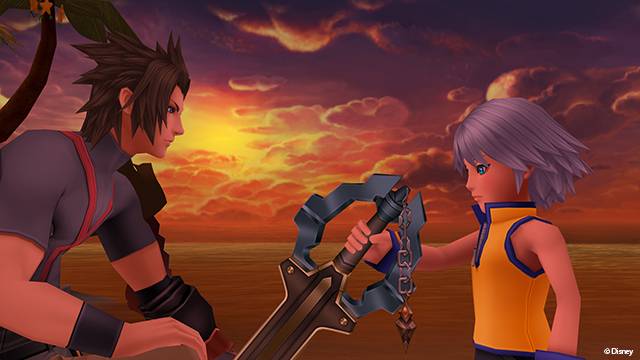 Image: Square Enix / Disney
The many distinctions between these heroes reinforce an excellent story preoccupied with identity: who these characters are, who they hope to become, and who their teachers expect them to be.
Terra’s fall feels a lot like that of Anakin Skywalker; he’s a hero-turned-villain, but Master Xehanort does more than tempt him with power. He deliberately cultivates Terra’s insecurity about the darkness inside him before stealing his body. Master Eraqus makes that manipulation possible because of his own dogmatic belief that darkness must be eradicated rather than understood. Upon learning that Xehanort intends to use Ventus to forge the catastrophic χ-blade, Eraqus decides that killing his own student is the righteous solution.
Later games prove how badly Eraqus misunderstands the human heart. Riku becomes one of the series’ most powerful and grounded characters only after he stops denying his darkness and learns to wield it without letting it define him. Terra never receives that guidance. He has been taught to interpret part of himself as evidence of failure, which proves fruitful for Xehanort to manipulate.
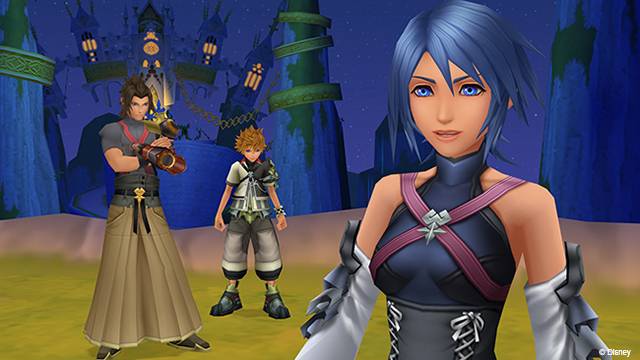 Image: Square Enix / Disney
Aqua alone earns the title of Keyblade Master at the game’s outset, and she spends the rest of the story proving why she deserves it. Her mastery isn’t merely a rank or measure of power. It positions her as the most experienced and wise of the three, which in turn makes her responsible for Terra and Ventus. After Ventus destroys the χ-blade and falls into a deathlike sleep, Aqua transforms their ruined home into Castle Oblivion to keep his body safe. When the possessed Terra begins sinking into darkness, she dives after him, sends him back to the Realm of Light, and takes his place in the abyss. Time after time, her competence empowers her to make the game’s greatest sacrifices.
Ventus’ fractured heart also leads to one of the franchise’s strangest mysteries. After Xehanort tears the darkness out of Ventus to create Vanitas, Sora’s newborn heart reaches out and helps fill in what is missing. That connection gives Vanitas the face of an older Sora, producing one of the series’ most unsettling reveals. When Ventus’ heart breaks again at the end of the game, it takes refuge within Sora.
This phenomenon is also why Roxas, the Nobody created years later from Sora’s body we meet at the start of KH2, looks like Ventus instead of Sora. It also helps explain why Sora and Roxas can each wield two Keyblades: They’re both connected to two distinct hearts and therefore can wield the weapons of both Sora and Ventus. Underneath all the talk of hearts, Nobodies, and metaphysical nonsense lies a surprisingly affecting idea. Appearance, memory, power, and identity can pass between people whose hearts are connected, and just because you’re a Nobody, it doesn’t mean you can’t be a somebody. Roxas may have Ventus’ face and spiky light-brown haircut, but he still becomes his own person.
The connection also gives Sora greater definition. He isn’t the most disciplined or technically accomplished Keyblade wielder. He’s also, quite frankly, kind of an idiot (albeit a lovable one). Aqua earns mastery before Birth by Sleep truly begins. At the start of KH3, Riku eventually achieves it, while it seems almost impossible for Sora (even though the qualification are murky at best). Sora’s unique power is his willingness to open his heart to other people and connect with them, and all that began when he unknowingly sheltered Ventus and essentially prevented him from dying outright.
This “side story” feels essential to Kingdom Hearts 4
Birth by Sleep was easy to dismiss as a handheld side story in 2010, particularly in a series that scatters seemingly essential chapters across the Game Boy Advance, Nintendo DS, mobile phones, and Nintendo 3DS. Thankfully, all of it is so much easier to play today. Kingdom Hearts Birth by Sleep Final Mix is included in Kingdom Hearts HD 1.5 + 2.5 ReMIX, available on PlayStation, Xbox, Steam, and the Epic Games Store, with a cloud version on Nintendo Switch. The remaster presents the game in HD at a smoother frame rate and includes additional battles along with a playable Secret Episode following Aqua through the Realm of Darkness. A new Kingdom Hearts Collection [I–III] release is also coming to Switch, Switch 2, PS5, Xbox Series X|S, and Windows on Oct. 8.
That makes this an ideal time to reconsider the game’s reputation as supplementary homework. Newcomers alienated by the franchise’s more childish Disney excursions can begin with its earliest major story and most human conflict. Returning players preparing for KH4 can revisit three heroes who have finally reentered the fight. The Disney worlds are still here, but for once, they are visiting Kingdom Hearts, rather than the other way around.
>> Home