It's an Orphfully long way down
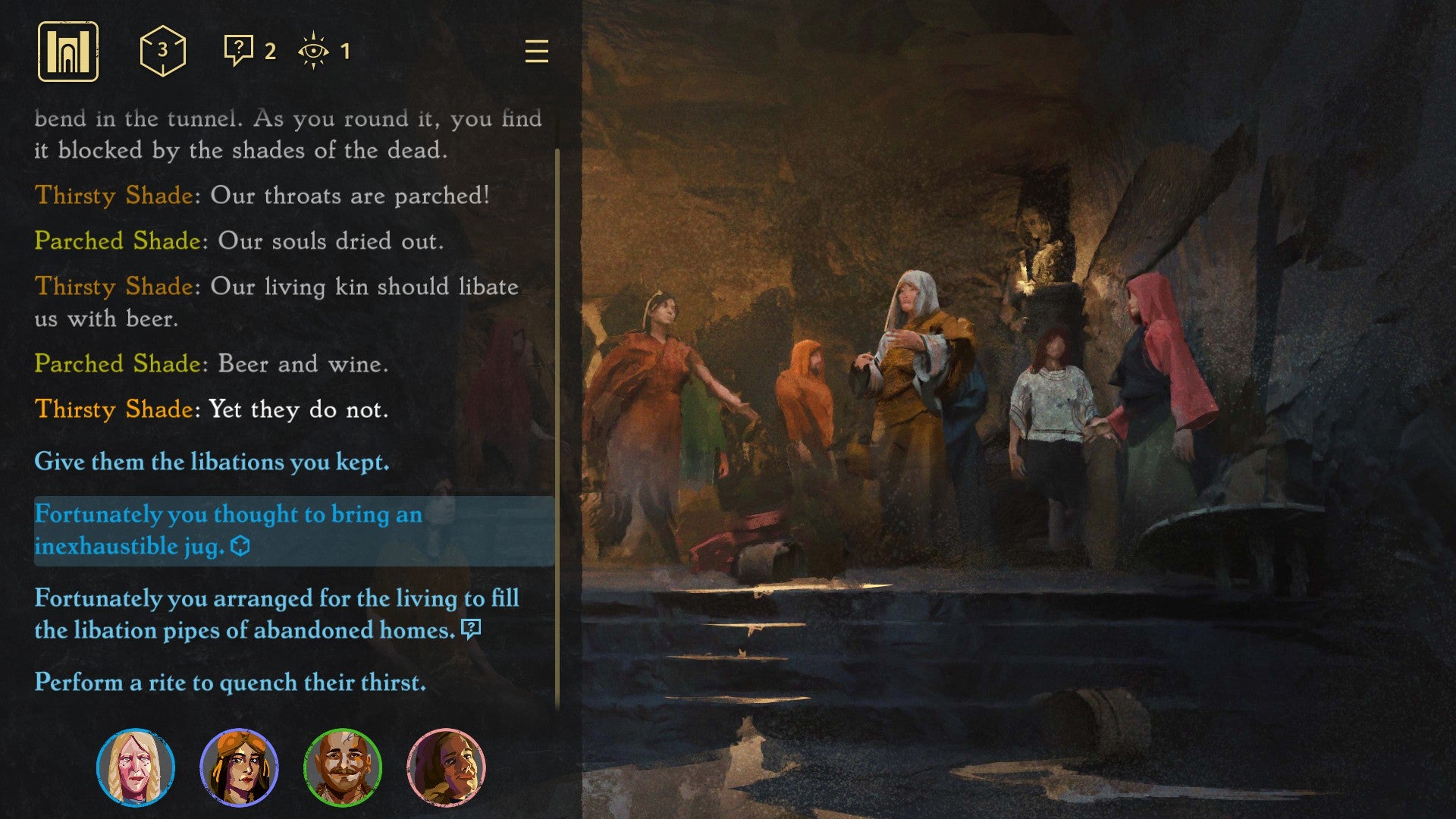
You'd expect a game called Thousand Hells: The Underworld Heists to be on the depressing side, but this choose-your-own-adventure RPG anthology from the designers of King of Dragon Pass is an absolute tonic. It's a witty procession of Orphic descents, in which you assemble a crew of four garrulous weirdos and pitch them against quest scenarios that might involve talking trees, holy riddlers, and conduits of boiling blood.
There's an infectious, venturesome lightness to the game, which somehow persists alongside dire blunders and supernatural calamities that may see members of your party being cursed, punctured or unhinged. I've only completed a couple of the 10 heists across two hours of play, which makes me reluctant to call this an official review, but it's got my provisional recommendation. Come, reader - get thee to Pandemonium apace.
Thousand Hells doesn't harbour a thousand distinct hells; its variety comes, instead, from choice of party members and the canny reshuffling of story beats, which play out against handsome paintings of monoliths, bazaars, shorelines and catacombs. Each run starts with your character accepting One Last Job from some dubious power-broker in the "Byzantine-flavored" Eternal City. Perhaps you'll be looking into the untimely deaths of some princelings, or maybe you'll be escorting a murderer: either way, you'll need to trek down to an underworld that borrows ideas from Ancient Greece and Mesopotamia.
The opening interview also defines your character, as you pick from backgrounds, strengths and faults. Ho thar! I am Caroline, seasoned sailor and scout, with the bestest biceps this side of the Hungry Sea. My major shortcoming: I like to make jokes about gods.
Having created yourself, you then recruit a crew of similarly imperfect adventurers, spending Question points to decide how much you know about them to begin with. A big hand for Sethre: diplomat, pickpocket and shaman, dream-dogged and impulsive. A round of applause for Hemze: catfooted spymaster, who looks like a bull's derriere. The characters you choose will form loose relationships, reacting to each other's traits as the yarn wears on. These relationships are strongly shaped by the task at hand, which might see you keeping secrets from your colleagues, or deciding in advance that somebody ain't coming back from the Great Below.
The heist itself consists of a series of round-based encounters drawn from a pack of over 280, each with a mix of solutions depending on your party's skillset. In a pleasing tactile device that makes me think yet again of Ursula K Le Guin, encounters are resolved using bags of tokens. Each round, you pull up to four tokens from three bags. You get one bag for the character you've selected to take charge of the encounter (which means you'll be able to play more of their tokens), and one for the rest of the group. A third bag houses tide-turning boons and knowledge you may have acquired by, say, befriending a sorrowful spirit, or jailbreaking a god.

The tokens mostly reflect each character's traits, both helpful and hindersome – "Nerinai is knowledgeable", "Chisu is greedy", "Sethre has a troubled past", "Esanth knows lockpicking". You apply these tokens to one of three actions, corresponding to the scenario. You're navigating the rapids of Styx: do you focus on the rocks, or on the unruly dead crowding the stern? You're helping the Fates weave your very own destiny: do you throw the shuttle, or offer to cut the warp threads?
Other, more generic tokens might grant you resources and buffs, or rid you of debuffs. Show Some Swagger will improve a character's morale, if played successfully, while Get The Measure earns you Insight points, which let you visualise the odds of each token being successful. Any tokens and actions not used up in a round carry over to the next, so you might want to reserve any tokens that could fit several possible actions. Conversely, you'll need to figure out when to dispose of tokens that seem bound to fail. "Hemze is ugly" probably does have a use at some stage – I dunno, maybe Narcissus is working a guard post somewhere, and you can invite him to give Hemze a makeover? - but I'm not sure it's going to help me rescue some drowning merchants.
You need to win a certain number of rounds, and avoid a certain number of losses, but fumbling the encounter doesn't end the game: you might incur an injury or receive a mood penalty, perhaps even lose a character, but you'll often achieve the story objective (like crossing a river) regardless. I've rarely felt the urge to reload a save, which isn't possible anyway.

While never a taut exercise in resource juggling, the encounter design does oblige a bit of strategy, thanks to some underlying combos and questions of timing. Some actions are best performed early, boosting your chances of doing something else – disarming traps before lunging for a treasure, for instance. Some are easier to do when you're ahead or behind on victory points. A few need to be reserved for the encounter's finale.
Sometimes you get a bunch of tokens that don't entirely fit any action, and must guess how the writers will play out the implications. So far, I've found those stabs in the dark more entertaining than jarring, but there have been a couple of moments when the storycraft felt somewhat meaningless, next to the invisible tallying of points. Over the course of the heist, you also need to think about gathering items that serve as quickfix solutions, sometimes allowing you to avoid an encounter.
As you'd expect from the whole "repeatedly going to hell" premise, the encounters can be pretty macabre. During my first run, I had to deal with some hags who can shave away character traits with a nasty look. During my second, I tackled a scenario for which a positive outcome would see a character being hung from a meathook.
There are plague crows, blade tsunamis, and mesmerising demons. Worst of all, there's a poetry contest. (I won the poetry contest, mostly by alternating between mockery of my opponent and flattery of the audience.) As grim as things may get, however, the writing remains brisk and buoyant, with characters squabbling a bit and maybe revealing something about themselves when they strike out, keeping up the momentum of the tale. I've come to love these little setbacks. It's like Scheherazade turning every tumble into a cliffhanger, with her head on the line. It's the kind of game in which a clean sweep feels like a loss, because you've bleached away the reversals and pratfalls that any thrilling adventure should involve.
Thousand Hells: The Underworld Heists is out now on Steam. I reckon you should give 'er a go, especially if you enjoyed the art and writing of King of Dragon Pass and its spiritual successor, Six Ages, but found the village management element tedious. I should mention that the game's writers include Holly Nielsen, who has done stuff for RPS in the past.
>> Home