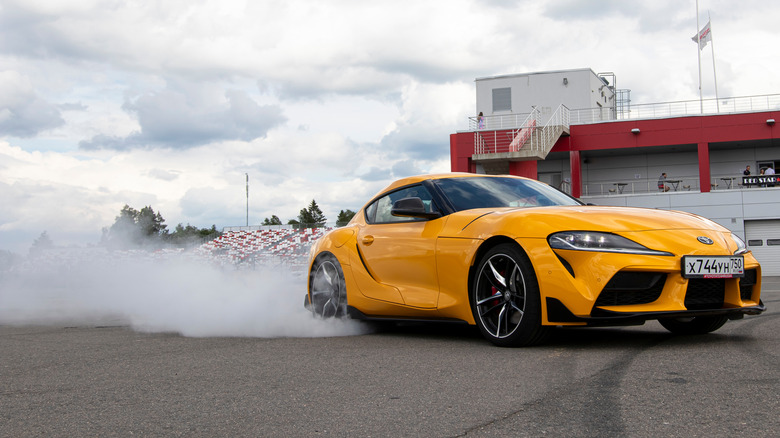
popartproduction/Shutterstock
With a chirp of its tires, the Toyota Supra blasts up the street, a menacing, curvaceous ball of turbocharged fury, hitting 60 mph in about the same amount of time as it has taken you to read this sentence. Through five generations, the Japanese sports car has come a long way from its beginnings as a luxurious version of the Toyota Celica in the '70s, including the latest version produced in collaboration with BMW. And nowhere is the evolution of the Supra more obvious than in its official 0-to-60 time.
A lot has changed in the auto industry since the Supra first launched, and there are significant differences marking each of the generations beyond the power outputs of their engines. Unsurprisingly, the newest is the fastest of all the Supra generations, but how do each of the five generations rank in the all-important 0-to-60 sprint? It's pretty much what you'd expect, with the newer generations being quicker than those that came before them. Arguably, a bigger question is: How far did Toyota advance its sports coupe in nearly five decades of trying?
And another: What's next for the iconic nameplate? It celebrates its 50th anniversary in 2028, and, given Toyota's renewed focus on high-performance cars — such as the inbound Toyota GR GT supercar – who'd bet against a revival of the Supra nameplate? It is likely that such a thing would outrank all the previous Supras in the 0-to-60 metric.
The origin of the species was a Toyota Celica: 10.2 seconds
In April 1978, Toyota took the covers off the Celica XX in Japan, a new two-door coupe that began as a glorified Celica, designed to be a grand tourer with a more luxurious cabin, the option of leather upholstery, and even additional sound deadening. It arrived in the U.S. the following year as the Celica Supra, internally known as the A40.
Offered with 2.0-liter and 2.6-liter engine options in Japan, the Celica Supra's availability with an inline-6 set it apart from the regular Celica — and only the bigger engine was available in America. Toyota retained the Celica's extravagant design language, but the Supra variant was wider and longer, especially at the front — presumably to fit in the larger powerplant. Among its technical specifications were four-wheel disc brakes on most grades and the option of a five-speed manual transmission or a four-speed auto.
Initially launched with a 2.6-liter unit producing 110 horsepower and 136 pound-feet of torque, the Celica Supra put in a respectable 11.2-second time for 0 to 60 mph in the hands of Car and Driver. It was Toyota's first engine with electronic fuel injection, too. Only a year later, Toyota significantly upgraded the big coupe, replacing the solid rear axle with an independent suspension design using semi-trailing arms and coil springs. At the same time, a new 2.8-liter inline-6 was launched, increasing peak outputs to 116 hp and 145 lb-ft. This car was unofficially called the A50. The upgrades were comprehensive, and Toyota claimed it covered the 0-to-60 sprint in 10.2 seconds. The first Supra's biggest rival was the Datsun Fairlady Z, which was a little quicker, but otherwise remarkably similar in layout, using a 6-cylinder engine, a two-door coupe body, and rear-wheel drive.
A hint at a more sporting future, with help from Lotus: 8.4 seconds
The second-generation Supra, the A60, was still officially called a Celica Supra, and it shared a lot with the lesser car when it launched in 1982. However, the Supra got a unique front end with pop-up headlights and an optional "aero" sunshade on the back window. Further differentiating the two was the Performance option for the Supra, bringing with it wider wheels and tires, necessitating the addition of beefy flared fenders. Inside, it featured highly adjustable sports seats with inflatable lumbar support.
Buyers could still choose between a five-speed manual or a four-speed automatic transmission, while much more equipment was fitted as standard to enhance the GT image. Included in the price were such luxuries as automatic climate control, power windows, and cruise control, while the Luxury version even got electronic instrumentation, including something called "Navicom," a precursor to modern day GPS-based satellite navigation.
Under the low hood was a further developed 2.8-liter inline-6, including double overhead camshafts. It launched with 145 horsepower, but by the end of its lifetime had been developed to put out up to 161 hp and 169 pound-feet of torque. Toyota's 0-to-60 time for this car was 8.4 seconds, a notable improvement on its predecessor. It was well received in the States, named Motor Trend's "Import Car of the Year," and was one of the chosen few in Car and Driver's "10 Best." Lotus in the U.K. was involved in the Celica Supra's chassis development, which happened because Toyota owned a stake in Lotus Engineering at the time.
Turbocharged performance and tech to the fore for the third iteration: 6.4 seconds
The Supra left its Celica name and foundations behind when the A70 was introduced in 1986, and it was a far more sophisticated vehicle than its predecessors. It launched with a new naturally aspirated 3.0-liter inline-6 producing up to 200 horsepower and 196 pound-feet of torque, with optional anti-lock brakes for the first time on a Supra. This generation also introduced double-wishbone suspension front and back, the first time Toyota ever deployed the layout — associated with motorsport — in mass production. On the style front, pop-up lights remained, and while the new Supra was a fraction lower and wider than the previous model, it was also more than an inch-and-a-half shorter. It could also be had with a "Sport Roof" in place of the hard coupe top, a little like the Porsche 911's Targa roof design.
In performance terms, the big news happened in 1987 with the introduction of turbocharging. In some markets, Toyota fitted two turbochargers to its 2.0-liter engine. For the U.S., the inline-6 received a single turbocharger, taking it to 230 horsepower and 254 pound-feet of torque for a rapid 6.4-second 0-to-60 time. That put it on a par with contemporaries such as the Porsche 944 Turbo and Nissan 300ZX. The turbocharged Supra came with a Sport Package as standard, including anti-lock brakes, a limited-slip differential, and electronically controlled damping — Toyota Electronically Modulated Suspension (TEMS) — allowing the driver to select from Normal or Sport settings.
The Fast and the Furious generation lived up to its billing: 4.6 seconds
The iconic status of the fourth generation of the Toyota Supra, the A80, was cemented by its inclusion in the first instalment of the epic 10-movie "Fast & Furious" saga in 2001. It launched eight years earlier, in 1993, and, though both engines were six-cylinder units, only one was turbocharged. Due to emissions legislation, only the naturally aspirated variant was available for the final year in California emission states.
Eye-catching style marked out the A80, notably the hoop-like rear spoiler on the Supra Turbo. The dramatic design was backed up by a focus on weight reduction and performance. Hollow-fiber carpets were used, the hood was made of aluminum, the fuel tank was plastic, and the rear spoiler was constructed of an innovative resin. The turbocharged version was about 125 pounds lighter than its precursor, despite using an iron block in the 2JZ engine instead of aluminum. This was for reliability purposes, to allow for further increases in power. It's almost as if Toyota knew it was going to become a favorite of the tuning brigade. The non-turbo model had 220 horsepower and 209 pound-feet of torque, while the Turbo upped those figures to 320 hp and 315 lb-ft, allowing for an official 0-to-60 mph time of just 4.6 seconds.
The A80 came with the option of automatic or manual transmissions — including Toyota's first six-speed manual. The auto came with a manual override, too. Later in the car's life, the naturally aspirated engine was fitted with variable valve timing, bringing peak power up to 225 hp, though by that time, the sale of the Supra was restricted, due to emissions regulations, and it was phased out before it could get as many sales as its predecessors.
BMW helped satisfy Supra fans' desires: 3.9 seconds
It took an age before Toyota brought the Supra name back to life. The FT-1 concept car of 2014 offered a tantalizing glimpse of what was to come, and in 2019, the wraps came off the fifth-generation Supra, the A90. The heritage of the nameplate appeared intact: This was a rear-drive sports coupe with a powerful six-cylinder engine under the hood. However, it was the first Supra not built in Japan. It was developed in partnership with BMW, with another result of the collaboration being the Z4 roadster in Final Edition guise.
Purists might not have approved of that, but the 3.0-liter BMW inline-6 put out 335 horsepower and 365 pound-feet of torque to the rear wheels, rising to 382 hp and 367 lb-ft for 2021. This had the effect of dropping the car's 0-to-60 mph time from 4.1 seconds to 3.9 seconds – the first time a factory Supra ducked under the four-second mark.
From a North American perspective, the runout model was the high-spec GR Supra MkV Final edition, unveiled in 2025 with braking, chassis, and suspension changes but no performance updates. Elsewhere in the world, the A90 Final Edition was offered with a serious upgrade — to 429 hp and 420 lb-ft. This only came with a manual transmission, however, and could not beat the official 0-to-60 time of the U.S. car.
>> Home