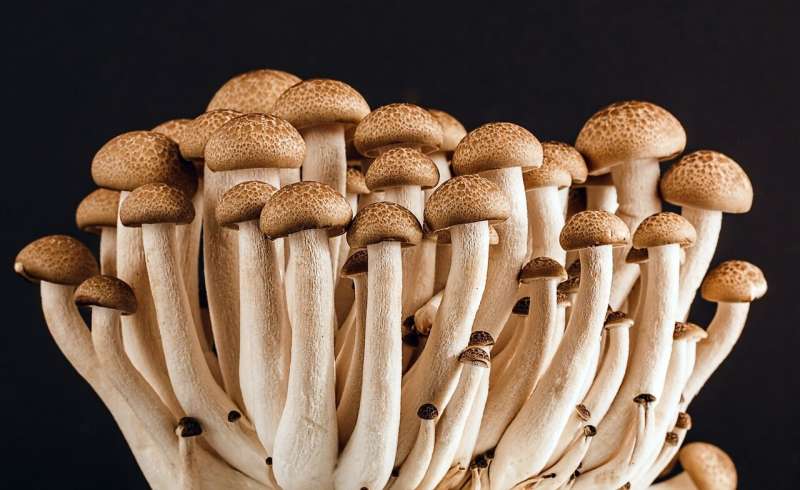
VUB researcher Maarten Ottaway investigated how trees and their invisible underground allies—the fungi—respond to soil pollution. His Ph.D. sheds new light on an age-old partnership that is crucial for healthy forests, and on how that partnership holds up under the pressure of metal pollution.
Most trees in the Northern Hemisphere live in symbiosis with so-called ectomycorrhizal fungi. These fungi form an extensive network around and between tree roots. They help trees absorb water and nutrients while receiving sugars from their host in return. This underground partnership is essential to the health of forests but is increasingly under pressure from human pollution, including metal contamination.
For his research, Ottaway studied the interaction between the fungus Laccaria bicolor and poplars. He examined how their symbiosis is affected by zinc and cadmium pollution, two metals commonly found in contaminated soils. "Metal pollution causes stress in both plants and fungi," Ottaway says. "We wanted to understand what happens to their partnership when they are exposed to metals such as zinc and cadmium."
The results proved surprising. While zinc inhibited the collaboration between the tree and the fungus, cadmium appeared to stimulate it. "This shows that not all metals have the same impact on the symbiosis," Ottaway says. "The response is much more complex than we initially expected."
In a second part of his research, Ottaway focused on the molecular mechanisms the fungus uses to respond to stress and adapt its growth to the environment. He discovered that exposure to cadmium can send a stress signal through the fungal network, even to parts that do not come into direct contact with the metal. "This suggests that there is an internal communication system within the fungus," he says. "Fungi appear to transmit stress signals over greater distances than we have been able to demonstrate so far."
In addition, he identified a particular protein that is thought to be involved in these stress responses. This protein appears to behave differently from similar proteins previously described in yeasts and pathogenic fungi. This is an initial step in research into new avenues for further unraveling the unique biology of ectomycorrhizal fungi.
According to Ottaway, the significance of the research extends beyond fundamental knowledge. "Forests play a crucial role in our biodiversity, in climate regulation and in carbon sequestration. To protect these ecosystems, we need to better understand how trees and fungi respond together to pollution and other forms of stress."
More information
Thesis: Impact of trace metals on ectomycorrhizal symbiosis with an emphasis on the role of cellular redox regulation
Who's behind this story?

BA art history, MA material culture. Former museum editor, paramedic, and transplant coordinator. Editing for Science X since 2021. Full profile →

Master's in physics with research experience. Long-time science news enthusiast. Plays key role in Science X's editorial success. Full profile →
Citation: Fungi communicate with one another in the presence of metal pollution in forests (2026, July 7) retrieved 14 July 2026 from https://phys.org/news/2026-07-fungi-communicate-presence-metal-pollution.html
This document is subject to copyright. Apart from any fair dealing for the purpose of private study or research, no part may be reproduced without the written permission. The content is provided for information purposes only.
>> Home