Deep within the bowels of San Diego’s federal courthouse, Assim Alkhawaja sat on the floor outside a nondescript office, waiting to be called for his ICE-mandated immigration appointment. He stared straight ahead, his posture tense, his face a mask.
The hallway was brown, as was the carpet. Above Alkhawaja’s head hung a framed stock photo of a waterfall. A few paces away, official government signs encouraged people without legal status to self-deport. “Leave on your own terms,” they read, in several languages. “Claim a free flight and an exit bonus for each member of your family.”
A woman emerged from behind the office door.
“Assim?”
Alkhawaja went in and the door closed behind him. The 53-year-old knew that, in the past, others in his situation had been detained and deported on the spot at these types of check-ins, without warning. Staff, who work for a program that is overseen by ICE, ask him the same questions here nearly every week: where do you live? Do you work? Occasionally: why are you applying for asylum?
This time, there was a new one: how are you feeling?
But that question was more difficult to answer. For months, Alkhawaja, originally from Saudi Arabia, had felt a swirling cocktail of fear and anger, a disturbing sense that he’d been treated like an animal.
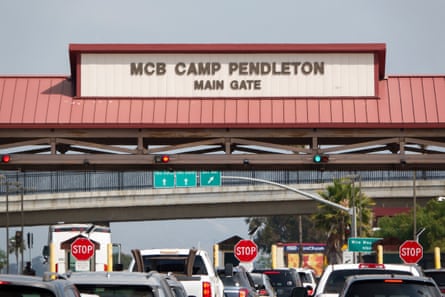
In February, ICE agents arrested and detained him while he was dropping off two Lyft passengers at Camp Pendleton, the sprawling military base in San Diego county. At first, Alkhawaja, who was working as a ride-share driver to make extra money, thought it was a misunderstanding – that he might even receive an apology. He has a valid work permit, a pending asylum case, no criminal convictions, a doctorate from the University of San Francisco, and a popular local coffee business that’s growing steadily.
Those things didn’t matter. Alkhawaja spent the next eight days in an ICE detention center and was placed in removal proceedings. His left ankle was strapped with a bulky GPS tracker, the kind that is typically only given to high-risk individuals on parole, like registered sex offenders. He must report to immigration officials on an almost-weekly basis, either at the courthouse or via home visits, to prove that he hasn’t absconded.
“I keep questioning myself,” Alkhawaja said, sitting in the sun outside the San Diego courthouse, sporting both the ankle monitor and a stylish quilted jacket. “Is this America?”
After ICE raids swept southern California and the rest of the country last summer, and then continued over the past year, thousands like Alkhawaja face a new normal: legal battles that will span months or years, constant monitoring by immigration officials, and a reset of their daily lives. All of it could end in deportation.
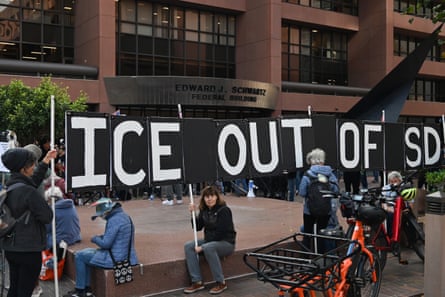
While more high-profile ICE raids in Los Angeles garnered national headlines last June, San Diego has also continued to see a constant, if not quieter, drumbeat of arrests – at the courthouse, Home Depots, military bases and outside schools. ICE has removed more than 16,000 people from the San Diego region alone between January 2025 and April of this year. And this summer, arrests across the nation have picked up again, with a record number of immigrants arrested since Trump took office for the second time.
“It ebbs and flows, when [and where] arrests happen. Sometimes it happens outside of a courthouse, sometimes it happens in the streets,” said Sydney Johnson, an associate attorney who works at an immigration law firm in San Diego. Johnson and the firm are representing Alkhawaja and his case.
“The tactics change, but the goal is the same – to make it harder for people to want to fight their case here, and to make them just give up.”
‘Like cattle’ in a detention center
On the morning of his recent immigration appointment, a balmy southern California weekday in June, Alkhawaja shapeshifted between several different personas in the span of a few hours: asylum seeker fighting to stay in the country, business owner making sure his nascent coffee shop stays afloat, and brother and friend trying to “live like normal”.
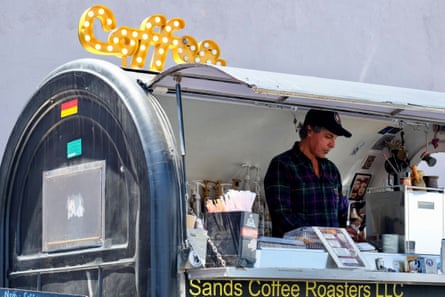
That day, he drove straight from the courthouse to a San Diego shipping facility, where he was picking up bags of coffee beans imported from specialty farms in Brazil and Colombia. Alkhawaja owns a nearby coffee cart called Sands Coffee Roasters, a small, family-run business that’s expanded into a neighboring brick-and-mortar shop over the past year.
As Alkhawaja helped load half a dozen burlap sacks of coffee beans into the back of his pickup truck, he looked different than he had an hour before. He was animated, smiling, wearing a new outfit. Workers called him “sir” as they brought out his coffee order.
“I’m more confident here,” he said. “We switch, we have to survive.”
When he first applied for asylum in 2024, Alkhawaja assumed immigration officials would consider this side of his life: the plans for his new business, his background in higher education.
“That’s what I thought,” he said. “That I would be considered a good immigrant.”
But a new reality began to unspool in February, at the entrance to the county’s largest military base, according to a sequence of events retold by Alkhawaja.
That night, around 6pm, Alkhawaja first pulled up to the main gate of Camp Pendleton. He and all other drivers entering the base were asked to show their driver’s licenses. Alkhawaja had never given Lyft rides to the base before, but it also didn’t cross his mind to be worried. He handed over his valid license to a guard, who scanned it.
“Wait a minute,” the man told him, and he disappeared back inside the guardhouse. Alkhawaja’s two Lyft passengers waited nervously in the back seat.
When the guard returned, he asked for another form of ID. Alkhawaja handed over his active work permit, which expires in February 2030. This time, the guard left again, he said, but returned with two ICE agents, who asked Alkhawaja if he had a court date for his asylum case. He replied that he did not.
“You’re coming with us,” they told him, according to his retelling.
Alkhawaja was informed that, yes, he was actively being arrested, he said. Then he was handcuffed: his wrists and ankles, connected by a chain that wrapped around his waist.
“It was as if I assassinated the president,” he said.
Camp Pendleton has worked specifically with ICE agents since at least 2025, when the base launched a “security initiative” with ICE to support “identity verification and access screening operations”. Across the county, ICE arrests at military bases have spiked. Johnson, Alkhawaja’s attorney, said his experience matched what she’s heard from others who have been arrested and detained at Camp Pendleton.
A spokesperson for the Department of Homeland Security wrote in an email that immigration officers “have the authority to question, without warrant, any alien or person believed to be an alien concerning his or her right to be, or to remain, in the United States”.
During the arrest, the agents took Alkhawaja’s phone, all of his IDs (including his Costco card) and the shoelaces from his shoes, he said. He was put in a van – with the restrictive handcuffs, he had to jump to get inside – and was driven to an office in downtown San Diego. Once there, he said an agent offered him $3,000 to leave the country immediately, rather than be detained. He refused. Later that night, another van took him to the Otay Mesa detention center, one of the largest immigration detention facilities in California, where he’d spend more than a week.
“We’re like cattle, animals,” Alkhawaja said of the center. “The process of transferring the detainee is really unhuman.”
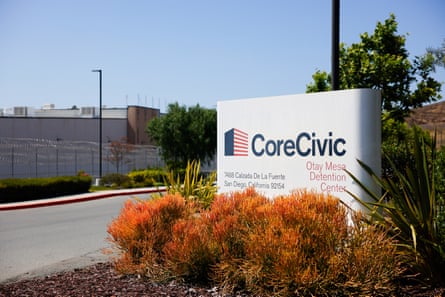
Inside the facility, Alkhawaja said, officials took the rest of his belongings: his hat, belt, jacket. He was given a uniform to wear for the duration of his stay: navy blue, with “DETAINEE” printed on the back in big block letters. He was then assigned to a room with eight other people, where the fear was palpable. Alkhawaja and the others didn’t know when they would be released, or if they would be transferred to other detention centers across the country.
Alkhawaja spent the next week settling into a kind of routine. Wake up. Go to the bathroom (detainees couldn’t use the restroom during the night, he said). Stand out in the yard. Watch the Fox News that was being played on the communal TVs. Return to the rooms to be counted. The drinking water smelled and tasted bad, he said, and it felt like everything cost money: phone calls, snacks, hygiene products. CoreCivic, the company that manages Otay Mesa, maintained in an email that the “safety, health and wellbeing of the individuals entrusted to our care is our top priority,” and that their water comes from “the same municipal source used by the surrounding San Diego community”.
How Alkhawaja was even able to be put in removal proceedings, while having a valid work permit and an open asylum case, comes down to a widening “grey area” between what is considered lawful and unlawful in ever-evolving immigration law, Johnson said. Asylum seekers can apply for and receive a specific type of work permit while their cases are pending, she said, but obtaining that permit doesn’t mean they technically have “legal status” in the US.
“It puts people in a bad spot, where they’re like: ‘But I did the right thing, I applied for asylum within the timeframe, and it’s not my fault that it’s pending,’” she said.
But that’s the unfortunate truth, Johnson added: “You can do everything right and you can still get screwed.”
In response to questions about how Alkhawaja’s arrest on the military base unfolded, the DHS spokesperson, who described him as “a criminal illegal alien from Saudi Arabia”, argued that Alkhawaja had also been arrested for “disorderly conduct” more than two decades prior.
“All of his claims will be heard by a judge,” the spokesperson said. “Despite his criminal history, this illegal alien was released on bond pending immigration proceedings.”
The fact that DHS had seemingly dug up an old unrelated arrest, and one that did not end with any convictions, was deeply unnerving to Alkhawaja.
He explained that in 2002, while on a trip to the US, he and an American friend were enjoying a night out in San Diego when they started chatting with a woman, who Alkhawaja later pieced together was an undercover police officer and was posing as a sex worker. Suddenly police cars surrounded the duo and they were arrested, but Alkhawaja said he was swiftly released once they got to the station. The whole situation was extremely confusing, he said, because he had been a bystander to the initial conversation and, to his knowledge, was never actually charged with a crime.
Johnson confirmed that Alkhawaja has no criminal convictions on his record.
“I believe they are bringing this up to try to justify their actions,” she said of the DHS comments. “The reality is a 2002 arrest when he was visiting his family here, without more, does not bar him from seeking asylum.”
As for conditions within Otay Mesa, the DHS spokesperson said that detainees in ICE facilities are provided with “proper meals, quality water, blankets, medical treatment, and have opportunities to communicate with their family members and lawyers”.
The dream of ‘living normally’
In June, by the time Alkhawaja showed up to Sands Coffee Roasters with the fresh shipment of beans, customers were already filtering in and out, ordering Turkish coffee, flavored lattes and freshly baked cookies.
Inside the store were typical coffee accoutrements: a commercial espresso machine, a big stainless steel roaster, display cases for baked goods. But there were also personal touches hanging on the wall: a photo of Alkhawaja’s family’s ancestral home in Palestine, and a traditional Palestinian embroidery, called tatreez, that his mother had made for him.
The center of the embroidery read, in Arabic: “May Allah protect you.” Translating that message, the weight of his current situation pulled down on Alkhawaja again. He hasn’t seen his mother, who now lives elsewhere in the Middle East, for two years. Whenever she asks him when he’s coming to visit, Alkhawaja tells her what she wants to hear. Maybe after the summer, he says, or some other time down the road.
Recently, Alkhawaja has often returned to another common worry: that he will now be viewed as a politicized caricature of a detained immigrant, as a “miserable, defeated person”.
How, exactly, he ended up here has been mystifying to him. “I wasn’t thinking that one day in my life I will live like this,” he said.
Alkhawaja is Palestinian, but he was born and raised in Saudi Arabia. He finally made the decision to apply for asylum, after years of visiting family and studying in the US, because he feared for his life back home. (Alkhawaja and Johnson requested that specific details of his asylum case be withheld due to safety concerns.) The next official hearing in his case is scheduled for October.
Since launching his fight to stay in the country, one thing has surprised Alkhawaja: the fact that people care.
When he emerged from Otay Mesa, he was shocked to see that a GoFundMe had been set up on his behalf, and was gaining traction. On a different day, dozens of mothers from a local activist group drove over to his coffee shop, kids in tow, to show support and hear his story.
Other strangers now trickle into the store. “We heard about you,” many have told Alkhawaja, he said, “and we just want to tell you that this is not right.”
If he’s granted asylum, Alkhawaja’s plan is to continue running the coffee shop, to “live normally, like others”.
“I want here to be home,” he said. “I started, and it’s hard to start again somewhere else.”
But in the end, it’s not up to him.
Next week, and the weeks after that, as he heads to his perpetual immigration check-ins, Alkhawaja’s family members will wish him good luck before he leaves, as they always do.
“It’s as if”, he said, “I’m going to a battlefield.”
>> Home