From
1h ago70,000 police officers and gendarmes to be deployed
The French interior minister says the government is mobilising 70,000 police officers and gendarmes- military officers who serve in the national police force – to city streets this weekend.
Riot squads and other elite, specialised units will be deployed. Even police trainees are being drafted in as support.
Laurent Nuñez said the government was aiming for an “extremely mobile, agile and effective” force. Some units will be stationed specifically outside government and public buildings as protection.
As I’ve noted earlier, several museums and tourist sites are closing this weekend – including Paris’s major museums the Louvre and Orsay – while shops and businesses are also boarding up.
Key events
38m ago
France protest bans criticised by the left and civil rights groups
1h ago
70,000 police officers and gendarmes to be deployed
2h ago
One dead, four injured in shooting in town west of Paris
2h ago
One dead, three missing in Black Sea strike
3h ago
Heat killed 50,000 people in Europe this summer
3h ago
France bracing for another weekend of protests
4h ago
Austria expels four more Russian diplomats suspected of spying
4h ago
Did Trump or Musk restrict Starshield access?
5h ago
Opening summary
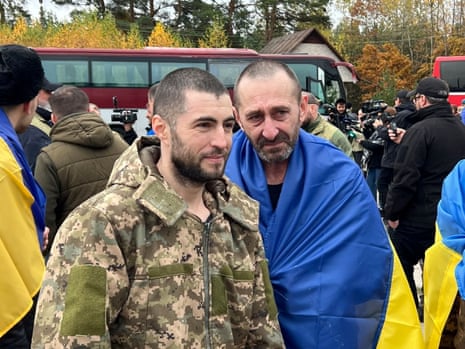
In Ukraine, Volodymyr Zelenskyy has said that a large-scale swap of prisoners has taken place with Russia.
Ukraine on Friday brought home 270 people, including nine civilians.
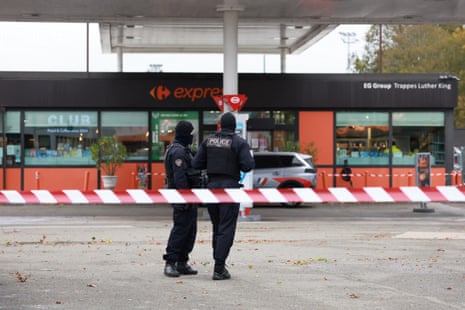
President Emmanuel Macron has commented on a shooting earlier today in the town of Trappes, west of Paris, which has left one person dead and wounded four others, including a 12-year-old girl.
On social media the French president said:
We would like to thank our law enforcement agencies, which have already taken the suspect into custody. The National Anti-Terrorism Prosecutor’s Office has taken over the case.
France protest bans criticised by the left and civil rights groups
It’s all a bit of a moveable feast at the moment in terms of where and when protests can or cannot be held this weekend.
Initially authorities in cities like Marseille and Lyon had issued blanket bans on any unauthorised demonstrations.
That prompted 1.) a rush by trade unions and student groups to file their protest plans with officials and negotiate march routes and
2.) last-minute legal challenges with plaintiffs arguing their constitutional right to protest is being suppressed by the government.
Trade unionists, lawyers, students, public intellectuals, and rights activists have all come out criticising the curbs on protest. The government says it’s trying to prevent a repeat of the looting, fires and violence seen last weekend.
Left-wing politicians also denounced the “headlong authoritarian rush” of the government. Far-left leader Jean-Luc Mélenchon’s party put out this statement this morning:
double quotation markBy deciding to ban demonstrations, to choose who has the right to organize them, to put in place curfews on the scale of a department or a city, to encourage traders to use private security, the executive is crossing one by one the limits that separate a democracy from an authoritarian and police state.
Furthermore, bans on demonstrations are foolish decisions that are likely to generate chaos. Indeed, these bans will not quell anger against the government’s policies, nor will they quell the desire to express it in the streets.
Meanwhile co-president of the Association of Criminal Lawyers, Romain Boulet, slammed the thousands of arrests that have occurred this week calling it: “The most repressive week in the history of the Fifth Republic.”
double quotation markNever before in France have there been so many arrests and so many people brought before the courts as this week.
The Justice Minister has just given an updated on sentencings- saying 232 people have been sentenced to prison since Saturday.
Elite units like the GIGN – the National Gendarmerie Intervention Group- and RAID (Research, Assistance, Intervention and Deterrence) are being activated tomorrow in the protests.
These units more commonly specialise in counter-terrorism events, hostage rescue, protecting senior state officials.
Nuñez defended their involvement in policing these street demonstrations of students, workers and civil servants. He noted calls on social media “from the far-left” to target public buildings.
“We are not talking about a peaceful, friendly demonstration,” Nunez told reporters. “We are ready tomorrow to be extremely firm and not tolerate anything.“
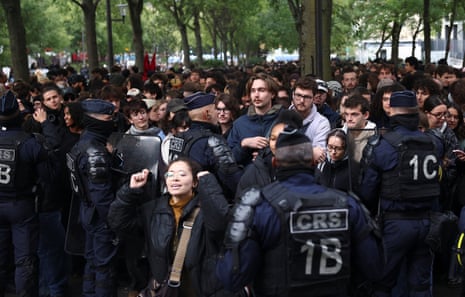
70,000 police officers and gendarmes to be deployed
The French interior minister says the government is mobilising 70,000 police officers and gendarmes- military officers who serve in the national police force – to city streets this weekend.
Riot squads and other elite, specialised units will be deployed. Even police trainees are being drafted in as support.
Laurent Nuñez said the government was aiming for an “extremely mobile, agile and effective” force. Some units will be stationed specifically outside government and public buildings as protection.
As I’ve noted earlier, several museums and tourist sites are closing this weekend – including Paris’s major museums the Louvre and Orsay – while shops and businesses are also boarding up.
Nuñez again condemned the vandalism and looting seen on the sidelines of protests last weekend – saying authorities would be “uncompromising” with “the vandals, with the looters and with all those who will commit atrocities”.
He also again repeated that some of this had been stoked by groups “on the far-left and radical extreme left” – but didn’t provide details.
“What happened on Octobe 17 is totally unacceptable. We will be fully in control to prevent these lootings, these attacks on public buildings” from occurring again, he said.
More than 200 people have already been jailed over last weekend’s violence.
French interior minister Laurent Nuñez is speaking now following a meeting of the Defence Council this morning, chaired by President Macron.
He begins by mentioning the shooting this morning in Trappes before going on to defending some of the blanket bans on demonstrations that have been issued in different regions across the country- saying each prefecture has the best idea of the security situation.
For example, until an hour ago, Marseille authorities had banned all demonstrations but the prefecture there has now allowed a trade union march to go ahead tomorrow.
Several local protest bans are also being challenged in last-minute court hearings today.
Nuñez will also be travelling to Orleans tonight to speak with law enforcement there ahead of the National Rally congress and counter-protests expected in the city tomorrow.
One dead, four injured in shooting in town west of Paris
The French prime minister Sébastien Lecornu has just issued a statement on a shooting in a town west of Paris this morning where one person was killed and four others injured.
Police said a gunman had opened fire in Trappes, in the Yvelines, and neighbouring La Verriere. The gunman was later arrested in nearby Coignieres.
Lecornu called it a “very serious event”.
Romania’s President Nicusor Dan has just now also blamed Russia for the Black Sea ship strike, where one sailor was killed and three others are still missing.
“This is clearly part of the escalation that Russia is carrying out in the context of the war in Ukraine,” Dan told reporters.
He’s given no other details so far.
French Interior Minister Laurent Nuñez is due to hold a press conference shortly on the specific measures for protesters this weekend.
We’ll carry a live stream of that at the top of the page.
There’s been a major crackdown on demonstrators; police have arrested 2,700 people since last weekend, Justice Minister Gerald Darmanin said yesterday. He added that courts have also already sent 217 people to prison– half of them first-time offenders.
One dead, three missing in Black Sea strike
I reported earlier Russia’s claim to having struck a cargo vessel in the Black Sea.
Romanian authorities are saying this morning that one person has been killed and three people are missing from a ship in the Black Sea.
They sent a rescue operation after the Khoryv vessel sent a distress signal around 0700 GMT while 13 nautical miles from the Romanian port of Constanta. There were 10 Ukrainian and three Azerbijani nationals in the crew, Romanian officials said.
“Rescue vessels have managed to recover nine people alive, and one body from the water,” the Romanian Naval Authority said, adding three others were missing.
There’s been a wave of drone attacks on merchant vessels in the Black Sea off Romania and Bulgaria in recent weeks. Romanian fighter jets shot down two Russian drones over the sea last weekend and NATO said this week it would deploy more planes and radar systems to the area.
Bulgaria is also holding a vote for the mainly ceremonial presidential role on Sunday. Election campaigns have mainly been focused on Russia’s war in Ukraine and the widening hostilities in the Black Sea.
Heat killed 50,000 people in Europe this summer
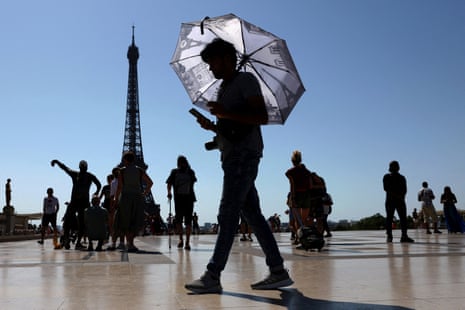
I’m going to track away from the French protests just slightly – although one of the demands of Parisian high schoolers is for air-conditioning and other basics in their classrooms – and highlight some shocking new numbers on just how many people died from the extreme heatwaves across Europe this summer.
Researchers from Imperial and London School of Hygiene and Tropical Medicine say the heat killed a record 50,000 people.
People succumbed to heat at the highest rates in Malta, Italy and Hungary, while absolute death tolls were greatest in Italy, France, Spain, Germany and the UK.
The “staggering” death toll, modelled using historical relationships between heat and health in 854 cities, is the worst on record.
Scientists are blaming climate breakdown for two in every three of the deaths. The share of deaths due to climate breakdown has risen from about 40% at the start of the century to 65% this summer, the study found – leading to an extra 32,000 deaths.
Because death certificates rarely record contributing factors – such as dangerous temperatures that push a stroke victim or lung cancer patient past their limits – families rarely know that heat and human activity hastened their relatives’ death.
France bracing for another weekend of protests
But Macron’s government has ramped up restrictions and protest curbs, to try and stop the looting and ransacking we saw on the fringes of the wider peaceful demonstrations last week.
Critics this morning such as civil rights groups, unionists and lawyers, are lambasting the “repressive” measures.
What protests are planned?
Both student groups and trade unions have planned rallies across the country. France’s main student union, UNEF, has called for demonstrations on Saturday and the Yellow Vest movement also filed plans to march through central Paris.
Marine Le Pen is also hosting the far-right National Rally congress in the central city Orléans, so we’re anticipating protests there with up to 30,000 counter-demonstrators expected.
What restrictions have kicked in?
-
There are already overnight curfews in place in Paris and many other cities.
-
In Marseille and Lyon, the second and third-largest cities, there is a general ban on demonstrations however some union groups have been authorised to hold marches.
-
The Marseille city government also initially said it would stop public transport running on Saturday; they’ve hastily reversed that severely unpopular decision this morning.
-
In Paris, protesters have been told they can only march a designated route between the Bastille and Nation squares.
-
Le Monde has this handy map on their site with all the curbs and restrictions and local curfew times
What’s the reaction?
-
Many shops and businesses, tourist sites and events are boarding up and closing for the weekend. Marseille’s business council advised shops to do so.
-
In Paris, the Louvre Museum will be shut while the Art Basel Paris art fair is also finishing up early.
What’s the government doing?
-
On top of the protest bans and restrictions in place, the government says they’ll deploy 20% more police onto the streets this weekend
-
Macron held a Security Council meeting on Thursday with senior ministers; he’s chairing a Defence Council meeting this morning discussing other measures with law enforcement
-
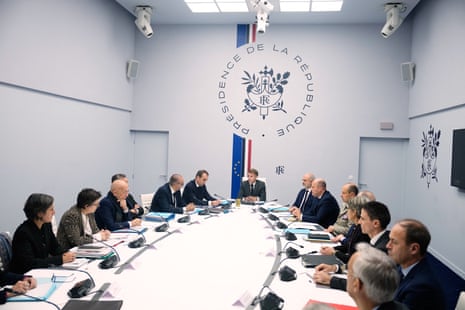
This afternoon the French president is also due to host student protest leaders for the first time for negotiations at the Elysee.
Austria expels four more Russian diplomats suspected of spying
In Vienna this morning, Austria’s foreign ministry has announced it is kicking out another four Russian diplomats over “activities incompatible with their diplomatic status” – a euphemism usually for espionage.
Three of them worked at the Russian embassy while the other worked at the Organization for Security and Cooperation in Europe) in arms control, Die Presse is reporting.
They had all been monitored for some time by the Austrian security authorities.
You have to wonder how many Russian diplomats are left in Vienna – Europe’s espionage capital since the cold war, as my colleague Jon Henley puts it. Just a few months ago, Austria also expelled three Russian embassy staff on spying allegations, after a “forest of antennae” was detected at the Russian mission.
Austria has expelled now 18 Russian diplomats since 2020.
A quick update from what the Ukrainian and Russian officials are saying this morning on overnight attacks:
Ukraine says Russia targeted energy sites in six different regions. Currently more than 500,000 people are without power.
Russia’s defence ministry confirmed strikes on Vilkovo port in Odesa, a railcar depot in Poltava and a cargo vessel in the Black Sea.
Did Trump or Musk restrict Starshield access?

Jonathan Yerushalmy
A war of words has erupted between the Trump administration, officials in Kyiv and Elon Musk over who is to blame for limiting Ukraine’s access to Space X’s military-grade version of Starlink.
The restrictions to Starshield have rendered many of the drones used by Kyiv to strike behind the frontlines inoperable and hampered air defence systems that stop Russian attacks, according to Ukrainian officials.
The US president said on Thursday that the service was running again at full speed, but a European official speaking to the Associated Press denied the service was fully functioning.
What has Trump said?
Trump initially denied any responsibility for the changes to Starshield, telling reporters last Friday: “I don’t know if it was anybody, but it wasn’t me, and I don’t think it was Elon,” referring to Musk, SpaceX’s CEO.
Trump’s cabinet backed him up, with secretary of state Marco Rubio saying on Wednesday: “What I can tell you with certainty is the president of the United States nor anyone in our system ever requested that any changes to that system be made.”
Rubio, however, also made a comment that threw suspicion on to Musk, the world’s richest man.
The president has nothing to do with the decisions that are made by Starlink and Starshield and by Mr Musk. That’s a private company. The president doesn’t run that company and can’t direct that company to do anything.
The Wall Street Journal reported on Thursday that the US president had asked Musk to restore the service, with Trump later telling reporters the system was “back”.
He refused to comment on whether he had spoken to Musk, but appeared to suggest the ultimate power to limit the service rested with the SpaceX CEO. “I guess the bottom line, he put it back,” Trump said, referring to Musk.
However, John Cornyn, a Republican who is in his final weeks as the US senator for Texas, told US media that he didn’t believe Musk would have acted “without at least the acquiescence of the White House”.
What about Musk? Musk has supported Trump’s calls for Volodymyr Zelenskyy to be replaced and has been highly critical of the Ukrainian president. However, he was quick to blame the limits on Starshield on the Trump administration, writing on X last week that the systems were “owned and controlled by the US government”.
Any limits on speed or usage are decided by the US military and ultimately POTUS.
Musk – one of the Republican party’s biggest donors and a Trump ally – continued to deny responsibility for the changes. However, on Tuesday the Wall Street Journal reported that Musk made the order to slow down Starshield, with the paper’s sources in disagreement over whether this was made in concert with Trump.
Vice-president JD Vance backed Musk on Thursday, saying the billionaire “doesn’t want to get in the middle of what is a war between two state actors without the United States government effectively directing him on what to do”.
So I don’t think this is about Elon. I think it’s fundamentally what is America’s policy in Ukraine and Russia going to be.
Amid the war of words, civilian casualties in Ukraine have surged, and the question over who is ultimately responsible for limiting Kyiv’s access has remained unanswered.
Opening summary
Good morning and welcome to our Europe live blog, where we’ll begin in Ukraine.
Local authorities reported explosions overnight in Lutsk, a city not far from the Polish border, and in the central Poltava and southern Sumy regions. Russia this morning has also claimed strikes on ships in the Black Sea.
Both sides engaged in heavy strikes yesterday with Russia bombarding Kyiv with ballistic missiles and Ukraine sending swarms of drones to Moscow.
Trump has declared that Starlink is once again running at full speed across Ukraine after the service was throttled last week -but Ukrainian and European officials say they haven’t seen that speed and functionality resume.
The satellite service was still only operating at a cap of 161km/hr, crippling key air defences and limiting mid-range strikes, a Ukrainian official told the Kyiv Independent after Trump’s comments. “Overall, nothing has changed anywhere,” the paper quoted the unnamed official saying.
Elsewhere we’re watching this continued wave of student-led protests across Europe. From Rome to Athens, Madrid and Paris, young people are venting their anger over the lack of resources in schools as well as wider housing and cost-of-living concerns. They’ve often been joined by their teachers in these ralies.
Fearing another weekend of street marches descending into violence and looting, French authorities have banned some protests over the coming days. President Emmanuel Macron, just returned from his mid-week tour to the Gulf states, is due to meet with student leaders around lunchtime in Paris.
It’s Frances Mao today in London, covering for Jakub, stay with me for all the developments.
>> Home