Follow
Link copied to clipboard

Published Oct 21, 2026, 10:00 AM EDT
Why so serious?
 Image: Sega
Sign in to your Polygon.com account
Spanning five cities and half a century, Stranger Than Heaven is Yakuza-maker Ryu Ga Gotoku Studio’s most ambitious project yet. During a half-day preview event in New York earlier in October, I played five different segments of the game, in three of the game’s five locations. As a longtime Like a Dragon fan, I came away dazzled by its sumptuous environments and fascinated by protagonist Makoto. But I'm still on the fence about certain aspects of the combat and storytelling.
I’m from the Bay Area, so I was especially excited to experience RGG’s riff on old-timey San Francisco in the prologue. Turns out, it’s not an explorable area, and the buildings and narrow alleyways had more of a generic East Coast feeling to me. Given how vividly this studio has captured real-world neighborhoods like Waikiki, Kabukicho, and Dotonbori in previous games, I was hoping for more, especially given the time period. (There was an extremely elaborate World’s Fair in San Francisco in 1915!) There’s certainly a lot of fog and it looks miserably cold at night, so at least that part is accurate.
Thankfully, the other cities I was able to explore were pretty darn spectacular. Centered around a foundry, Kokura is a traditional Edo-period town on the brink of modernization. People leave their doors open, and you can walk into almost every space — and you’ll want to, because there are so many lovely details to look at. Everyone and everything is covered in soot. Men play card games and spin beigoma tops for petty cash while chain-smoking. Makoto’s wooden geta sandals make a distinctly melodic noise as he walks the stone streets. If you enjoyed the historical tourism of 2023’s remake of Like a Dragon: Ishin, Yakuza’s samurai spin-off, the thrill of exploration here is upped by several orders of magnitude.
But while Stranger Than Heaven’s environments are beautiful and distinctive, they aren’t particularly welcoming. After being subject to incessant discrimination and even framed for murder in San Francisco, Makoto hopes for greater opportunities in his mother’s country of birth. So he stows away on a ship bound for Japan, where he instead finds a different flavor of racism. Whereas the dirty cops in San Francisco disparaged him as a “yellow man,” in Kokura, passersby comment on his large stature and call him “ketō,” a Japanese slur for white people that roughly means “hairy barbarian.”
As you explore Kokura, popping into stores, weaving past glossy red trolley cars, and trying your hand at various games of chance, the slurs and comments directed at Makoto are incessant. Everywhere you go, it’s “ketō.” Men and women alike stop in their tracks and look Makoto up and down in uncloaked disgust — despite him being conspicuously handsome by today’s standards. It’s startling, and punctures the charming veneer of a traditional Japanese town. It reminded me a bit of the Great Ace Attorney games in this regard, although a surly look is far more likely to escalate into violence here than in Capcom’s visual novels. Though it’s tempting to romanticize history, Stranger Than Heaven is refreshingly blunt in its assessment that the past was actually pretty shitty for most people.
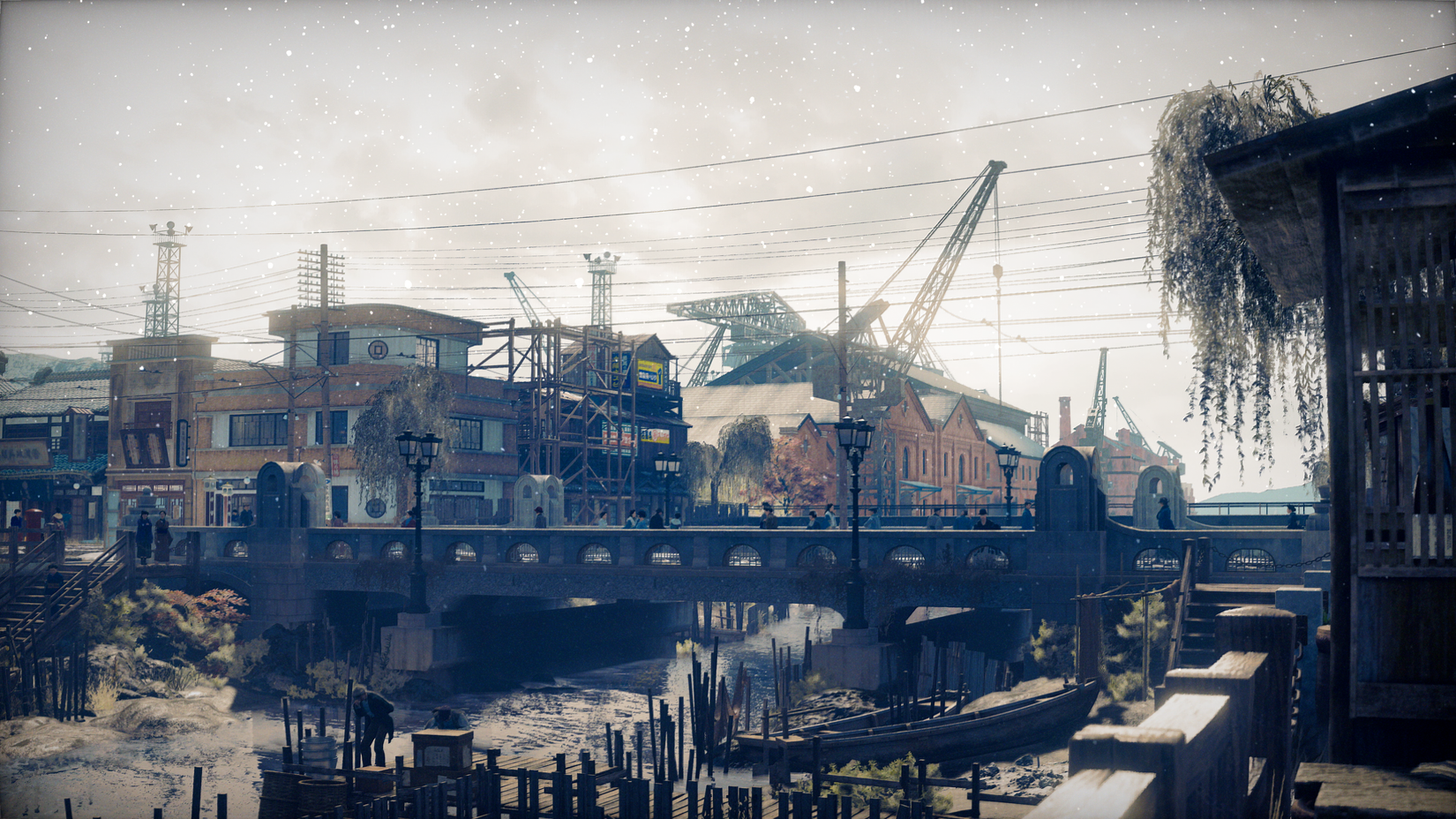 Image: Sega
Given their outsider status, Makoto and his fellow stowaway Yu soon fall in with a local gang known as the Yashima clan. Eventually, Makoto gets an important assignment: embarrass the head of a rival gang, Oki, by stealing his mistress. Makoto enters a café and asks for Tae, as customers openly grumble about the revolting foreigner in their midst. She emerges, warm and gracious, a prototype of the many beguiling hostesses Yakuza protagonist Kazuma Kiryu will chat up in glitzy nightspots a century later. Tae puts Makoto at ease despite his obvious nerves, and the pair share several beers and an evening of lively conversation. It’s an endearing scene. Despite his purported mission, Makoto is clearly besotted by the heady cocktail of Tae’s charm, the booze, and the fact that someone’s actually being nice to him for a change. As service in the cafe winds down, Tae invites him home.
This is where things get interesting. During the course of their evening together, Tae reveals that she was “sold” at the tender age of 12, one of too many daughters. It’s not a trauma dump, but a plain statement of fact. She tells Makoto she dreams of leaving Kokura one day to become a singer. She undresses, revealing her upper arms and back are spangled in vivid bruises, presumably from Oki’s mistreatment, though she does not comment on them. She asks if Makoto is a virgin — again, shades of Kazuma Kiryu — and he vows to return once he has proven himself “worthy” of her affections. Though they do not sleep together, Makoto allows himself to be seen leaving her home, and rumors soon spread. All of this has the makings of a potentially interesting romance, dare I say a potentially interesting woman character, something the Yakuza series has been woefully lacking.
But not so fast: Later in the Kokura section, Oki kidnaps Tae in retaliation for the perceived affair, and Makoto and his fellow members of the Yashima clan must fight their way through the metalworks to rescue her. It’s a classic Yakuza battle gauntlet, culminating in a boss fight. (More on that in a bit.) He’s able to save her, but after this section the demo skips ahead to later eras… and it’s the last we hear about Tae.
I’m not sure exactly what happens yet, but it sure smells like a setup for a classic case of fridging, a narrative trope where women are harmed or killed to give men emotional motivation. And boy, this would neatly explain Makoto’s interest in music in later sections of the story. Tae meeting a tragic end due to Makoto’s underworld beefs would also echo the fate of Kiryu’s love interest, Yumi, in the original Yakuza. But I’m more willing to overlook a choice like that in a game from 2006 than a game from 2027. I sure hope my suspicions are wrong, and Tae leaves Kokura for a better life someday. Or, you know, doesn’t die young just to inspire a man!
Anyway, back to the fighting. Promotional materials and earlier previews for Stranger Than Heaven have emphasized the game’s more realistic and visceral two-handed combat, compared to the arcade-style action of the Yakuza series. As someone who thoroughly enjoys stringing together boneheaded combos and then whomping some creep in the face with a bicycle, I’m not entirely convinced that more complicated was the way to go here, even if I didn’t struggle with fights as much as I initially feared.
Even after a couple hours, fighting with the shoulder buttons never felt particularly intuitive, and I was constantly misjudging the timing for blocks. In hectic moments, like a close-quarters boss fight in the Kokura foundry, I kept defaulting to ineffectually jamming on the face buttons. The inability to cancel animations and having to press down on the analog stick to dash felt frustratingly slow at times, rather than satisfyingly hefty. Clearly, I’m not the only one who’s struggled with the combat; during the preview, director Minoku Abe mentioned that RGG has added an optional suit to the game, accessible via Makoto’s room, that allows you to absorb a lot more damage. I’ll probably take advantage of it in my full playthrough.
On a brighter note, Stranger Than Heaven’s weapon system is a lot of fun. Yes, you can still interact with things in the environment, using nearby items like crates and wooden boards to throttle your enemies. But Makoto can also keep an arsenal of slicing, stabbing, and bludgeoning weapons handy at all times, which can be upgraded at blacksmith shops. It’s similar to how weapon upgrades worked in Like a Dragon: Ishin, instead of having an item break after a certain number of strikes like in the mainline Yakuza games. What’s more, these items carry over between time periods and get far stronger the more you refine them.
 Free sign-up
Get Polygon’s Wishlister newsletter
A weekly cheat sheet to what you’ll eventually love to play. No buying, no commitment — just saving for later.
Sign up free
Free. Unsubscribe anytime.
A well-executed weapon strike can easily clear out half or two-thirds of an enemy’s health bar, which is more realistic and satisfying… when you’re doing it to an enemy. Trouble is, the bad guys can do the same to you. During a section set in the Minami neighborhood of Osaka during the 1940s, I was busy gawping at the scenery when some jerkoff attacked me from behind without warning, killing me in just two or three strikes before I could get my act together to respond. Unlike the Yakuza games, Stranger Than Heaven doesn’t throw up an interstitial card that says “thugs” or “assholes” to indicate you are now in a fight.
It’s a small change, but it ties into one of the biggest questions I still have about Stranger Than Heaven. Is it going to be funny? Because most of what I saw during this preview was emphatically not funny, though there were a few exceptions. During the prologue, Makoto tries to elude the cops by wearing a blonde woman’s wig that he yoinked from a mannequin. I also chuckled when Tae asked Makoto if he was a virgin, but that’s mostly an inside joke about RGG protagonists being stupid with women. A scene where Orpheus’s goons threaten to kill Makoto and Yu for being stowaways is played for laughs, but lands more in “oh no, are these guys serial killers?” territory.
 Image: Sega
I understand that flashing the word “assholes” on the screen in a massive font may not work with the historical epic tone RGG is going for here. My preview event also didn’t include any substories, which may well be where the lighthearted side of Stranger Than Heaven lives. Yet, as I wandered around Kokura, Kure, and Minami in search of kindly old ladies and diaper fetishists, it seemed like everyone just wanted to fleece me at gambling, stab me with a farm implement, or call me a slur.
That said, one of the great satisfactions of Stranger Than Heaven thus far comes from watching society evolve from era to era. Muddy streets and women selling themselves in windows in 1915 eventually gave way to glamorous nightclubs and well-dressed ladies singing onstage in the ‘40s. A soot-stained crowd of glaring bigots in Kokura becomes a giggling sea of well-heeled tourists in western-style clothing in Minami. Perhaps the typical Yakuza level of humor would distract from that vision of a changing world, and it’s something that’s truly unique and special about Stranger Than Heaven.
Either way, come January, I’m along for the ride. But I still have a lot of questions.
Stranger Than Heaven will be released for PlayStation 5, Windows PC, and Xbox Series X on Jan. 15, 2027.
>> Home