Oakcitydrone/Getty Images
The Interstate Highway System celebrated its 70th anniversary earlier this year. While the monumental network spans nearly 49,000 miles across the country, the interstates were designed with features to make wayfinding intuitive. For example, exit-numbering standards were set so drivers know where exactly they are along the highway. The Global Positioning System–another freely accessible product of the American government–might have made modern navigating an afterthought, but these old-school features can prove vital in other situations.
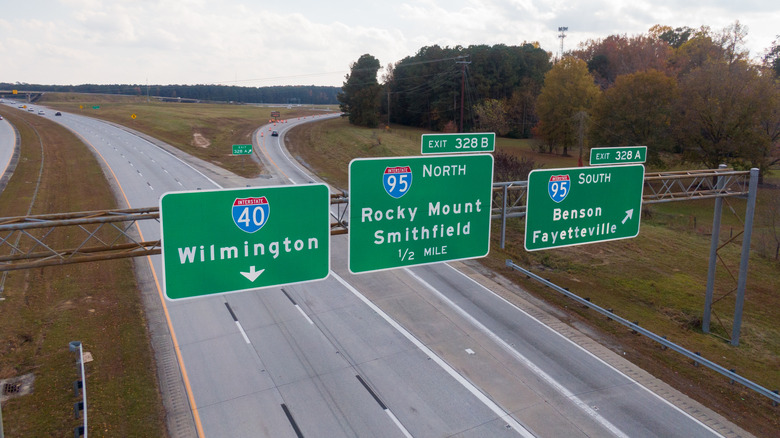
The expectations around exit numbering are stipulated in the Manual on Uniform Traffic Control Devices, the bible for federal road standards. The MUTCD mandates that U.S. states designate an interstate highway's westernmost or southernmost point with its borders at reference mile zero. The exits are then numbered based on how many miles they are from the origin. A hypothetical "Exit 4" would be four miles from mile zero. If there is more than one exit at a single reference mile, then each exit will have a suffix letter.
Some states are hesitant to change their exit numbers

Pabradyphoto/Getty Images
As with most standards, there are exceptions. The Federal Highway Administration didn't mandate exit numbering in the MUTCD until 1970. While a mileage-based system was preferred, states in the Northeast were allowed to continue using their traditional sequential numbering.
The resistance to the national standard stemmed from the region's highways predating the Interstate Highway System: the New York State Department of Transportation experimented with a mileage-based system, for instance, in the 1970s but never adopted it. The agency noted it has plenty of exits packed together within the same miles in urban areas. That would result in several exits using the same number with an alphabet soup of suffixes.
Eventually, the 2009 edition of the Manual required that every state use mileage-based exit numbers. Refusal to convert would result in a loss of federal road funding, but there wasn't a deadline for completion of the transition. NYSDOT is still converting its exit numbers, for example, gradually doing so corridor-by-corridor.
Despite the foot-dragging, a mileage-based exit numbering system is objectively better: exits can be added or removed without having to renumber every single exit along the route; drivers can report the exact mile-accurate location of crashes and other incidents by just glancing at an exit sign. It's just that no agency wants to spend the money to change every single sign.
>> Home