Scott Olson/Getty Images
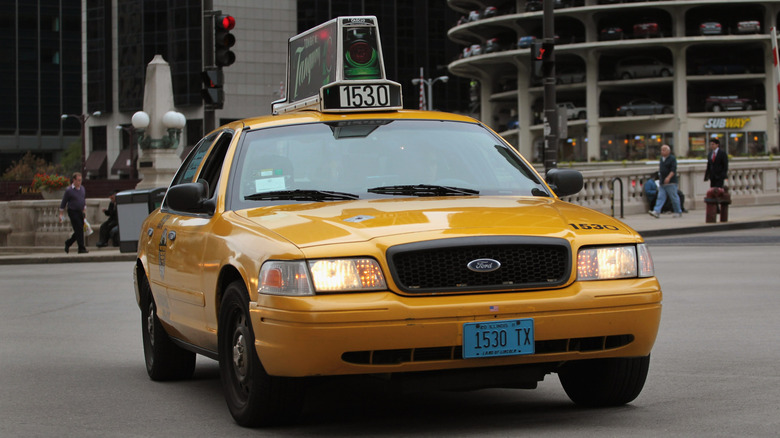
While sedans seem poised to make a comeback thanks to SUV fatigue, high gas prices, and young people, what's likely not going to find its way back is their body-on-frame variety. The last time one of those cars left a production facility was in 2011. We're talking about Ford's 1998 to2012 Panther-based full-size offerings, namely, the Crown Victoria, Mercury Grand Marquis, and Lincoln Town Car.
Consider how MotorTrend summed up the 2006 Crown Vic: "Nothing of any significance for 2006." Really, the only noteworthy positives were the car's size and its old-school vibes. In fact, sales were so low that around 2006 the vast majority of Crown Vics were either made for the police or for use as taxis. Though you could still buy a pickup or an SUV if body-on-frame was a non-negotiable, the writing was on the wall for a rear-wheel-drive, body-on-frame American V8 sedan. But why did such sedans fall out of favor among automakers?
This brings us to the unibody versus body-on-frame debate. While both approaches have their fair share of pros and cons, for a sedan body style, it makes a lot of sense for carmakers to switch to a unibody construction. It's lighter, quieter, cost-effective, and arguably offers a more comfortable driving experience. Besides, body-on-frame's advantages of better towing and off-roading are typically not something that sedans are associated with. To put things into perspective, a unibody 2008 Ford Taurus, when compared to a 2007 Crown Vic, is more powerful, roomier, packs AWD, and delivers better fuel economy — things the aging Panther platform could barely offer.
The second and third nails in the coffin

Andy Sutherland/Shutterstock
Changing consumer preferences also played its part in the decline of sedans, as did the Corporate Average Fuel Economy (CAFE) standards. And since many modern SUVs and crossovers are of a unibody construction, they tend to drive and corner better while sipping less fuel than their traditional body-on-frame counterparts. So, not only do customers have a vehicle that more or less drives like a car, but they also have the flexibility of more space, more seating, and better visibility, which are typically compromised in a sedan body style.
Then there's the automakers' incentive structure. What's interesting about CAFE standards is how they treat cars and light trucks differently, with the latter getting a bit more leniency. The fuel economy threshold for light trucks between the 1990s and early 2000s was around the 20 mpg mark, whereas the threshold for cars was much closer to 30 mpg.
Whether body-on-frame or not, sedans were categorized as cars, and those that weren't particularly good on fuel dragged down the corporate fleet average, penalizing automakers. But many body-on-frame SUVs and pickups are categorized as light trucks, for which the standards are far more forgiving, allowing carmakers to divert resources toward a segment that met federal requirements relatively easily.
>> Home